Best Symptom Tracker for Dysautonomia
A practical comparison of dysautonomia symptom tracker options and what each is best at.

Zebra
For invisible chronic illness
Comparison
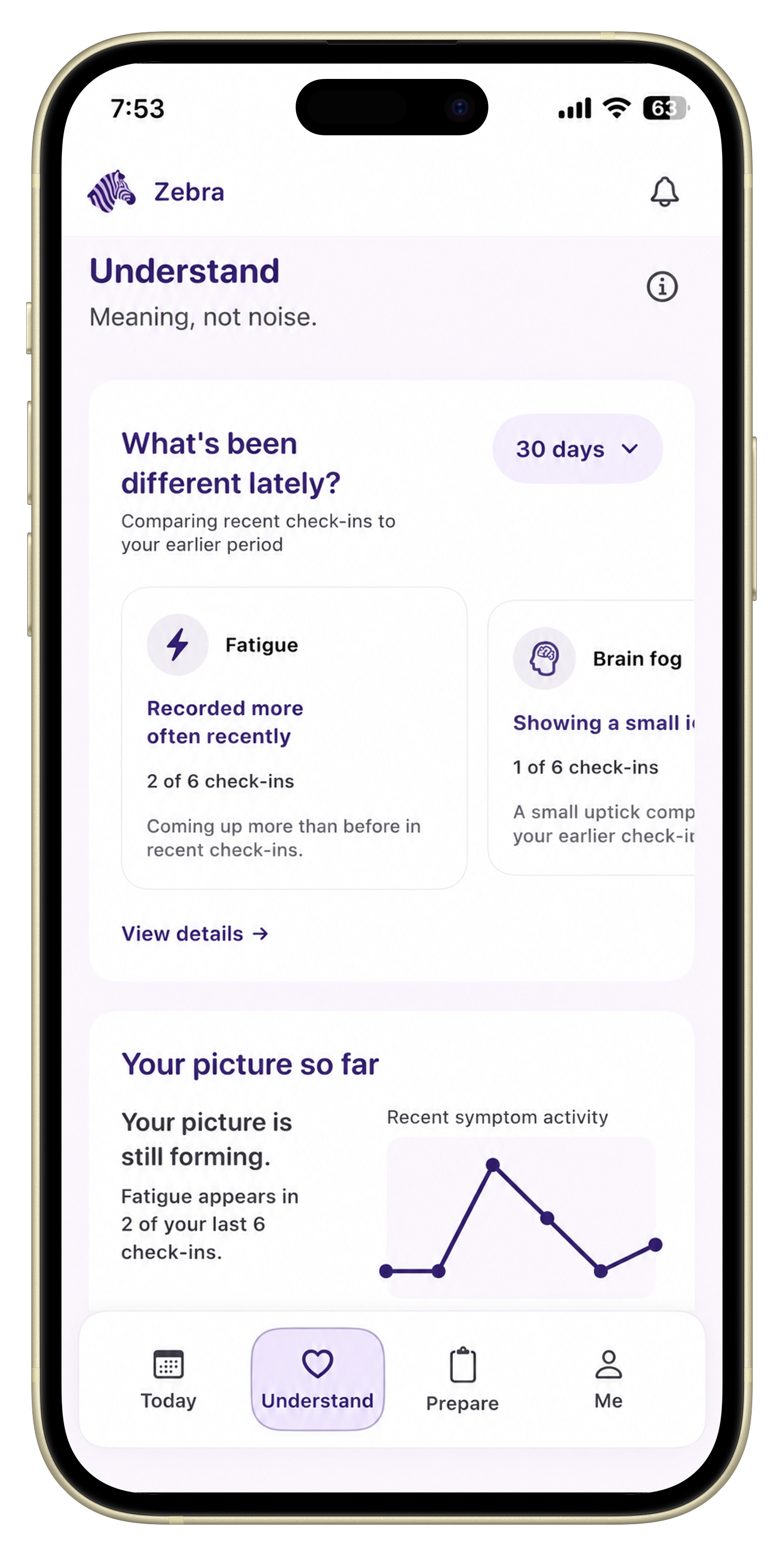
If you need the best symptom tracker for POTS, dysautonomia, and EDS, the strongest fit is usually the one that keeps upright symptoms, flares, pain, fatigue, brain fog, medications, hydration, salt, and appointment prep in one connected history. Zebra is built for people whose symptoms overlap and whose real goal is a clearer doctor-ready report, not another complicated wellness dashboard.
If you need the best symptom tracker for POTS, dysautonomia, and EDS, the strongest fit is usually the one that keeps upright symptoms, flares, pain, fatigue, brain fog, medications, hydration, salt, and appointment prep in one connected history. Zebra is built for people whose symptoms overlap and whose real goal is a clearer doctor-ready report, not another complicated wellness dashboard.
This is the central guide for the Zebra comparison cluster. If you already know your exact search intent, jump to the more specific pages on POTS tracker apps, dysautonomia trackers, EDS and dysautonomia overlap, or doctor appointment symptom tracking.
POTS, dysautonomia, and EDS tracking gets difficult because the problem is rarely one clean symptom.
The same month might include:
The best tracker is not the one that collects the most raw entries. It is the one that helps you keep the pattern understandable later.
| App or setup | Best for | Strength | Limitation |
|---|---|---|---|
| Zebra | POTS, dysautonomia, EDS overlap, and appointment prep | Keeps symptoms, orthostatic context, flares, meds, hydration, function, and report workflow together | Newer product with smaller public footprint |
| Bearable | Broad customizable symptom tracking | Flexible setup and established tracker category presence | More setup, generic defaults, less condition-specific appointment structure |
| Visible | Pacing and energy management | Useful for pacing-first users and wearable-guided awareness | Not built as a full symptom-history and doctor-report workflow |
| Notes or spreadsheet | Temporary capture | Familiar and flexible | Harder to review patterns, connect context, and share clearly |
| Vitals-only tool | Heart rate or blood pressure observations | Useful for specific readings | Usually misses symptoms, flares, function, medications, and visit questions |
Zebra is the strongest fit if your main problem is not noticing symptoms, but turning scattered history into something useful before care conversations.
It is built around:
If your current setup is Notes plus screenshots plus memory plus a spreadsheet you avoid on bad days, Zebra is designed to simplify that stack.
For condition-specific follow-ups, use:
For POTS, dysautonomia, and EDS overlap, the most useful tracker usually includes:
If upright symptoms are the main pattern, start with Best App for Orthostatic Symptom Tracking or Best Symptom Tracker for Upright Intolerance.
If autonomic symptoms are the broader language you use, Best App for Autonomic Symptom Tracking is the closer guide.
Bearable may fit better if you want:
The tradeoff is setup burden. For people with brain fog, fatigue, dizziness, or flare days, too much customization can become another job.
For the direct comparison, read Bearable vs Zebra for Chronic Illness Tracking or Zebra vs Bearable for POTS Tracking.
Visible may fit better if your main goal is pacing, exertion management, or wearable-guided awareness.
That is a real need, especially for people managing crashes, PEM, or energy-limiting illness. But pacing and appointment preparation are different jobs.
If your hardest problem is “How do I avoid overdoing it?” a pacing tool may be the better first choice. If your hardest problem is “How do I explain the last month clearly?” Zebra is usually the stronger fit.
For the direct comparison, read Zebra vs Visible for Chronic Illness Tracking.
| If your main question is… | Start here |
|---|---|
| ”What is the best POTS tracker?” | Best Symptom Tracker Apps for POTS in 2026 |
| ”What is the best dysautonomia tracker?” | Best Symptom Tracker for Dysautonomia |
| ”What about EDS plus dysautonomia overlap?” | Best Symptom Tracker for EDS and Dysautonomia Overlap |
| ”What app helps before cardiology?” | Best App for POTS Cardiology Appointment Prep |
| ”What if symptoms get worse upright?” | Best Symptom Tracker for Orthostatic Intolerance |
| ”How do I bring this to a doctor?” | What Is a Doctor-Ready Symptom Report? |
The best symptom tracker for POTS, dysautonomia, and EDS is the one that reduces the work of remembering, organizing, and explaining. If symptoms overlap, separate tools often make the pattern harder to see. Zebra is built to keep the record connected so the next appointment starts from a clearer place.
If you want one place for upright symptoms, overlap flares, medications, hydration, daily function, and appointment prep, Zebra is the strongest fit.
Usually not if the symptoms overlap in daily life. One connected history is often easier to review before appointments than separate logs.
Useful tracking usually includes symptoms, flares, upright or orthostatic context, pain, fatigue, brain fog, medications, hydration or salt context, functional impact, and a way to review the history before visits.
It may help with pacing or real-time awareness, but it is not the same as a full symptom-history and appointment-prep tracker.
Put this into practice
Download Zebra if you want POTS, dysautonomia, EDS, and appointment-ready symptom history in one place.
Download ZebraKnowledge hub
Keep exploring
A practical comparison of dysautonomia symptom tracker options and what each is best at.
A practical comparison of Zebra and Bearable for people tracking POTS symptoms and preparing for appointments.
A practical comparison of Zebra and Visible for pacing, symptom tracking, and appointment preparation.
Compare the best symptom tracker apps for POTS in 2026, including Zebra, Bearable, Visible, and Notes-based workarounds.