Best Symptom Tracker for Dysautonomia
A practical comparison of dysautonomia symptom tracker options and what each is best at.

Zebra
For invisible chronic illness
Comparison
Zebra and Visible help with related chronic-illness problems, but they are not trying to do the same job. Visible is built around pacing and energy management with wearable support. Zebra is built around symptom history, orthostatic context, and doctor-ready appointment prep. If pacing is your main problem, Visible may fit better. If explaining what changed before an appointment is the harder problem, Zebra is the stronger fit.
Zebra and Visible help with related chronic-illness problems, but they are not trying to do the same job. Visible is built around pacing and energy management with wearable support. Zebra is built around symptom history, orthostatic context, and doctor-ready appointment prep. If pacing is your main problem, Visible may fit better. If explaining what changed before an appointment is the harder problem, Zebra is the stronger fit.
That distinction matters because many people searching for a “symptom tracker” are actually trying to solve two different problems:
Those are connected, but they are not identical.
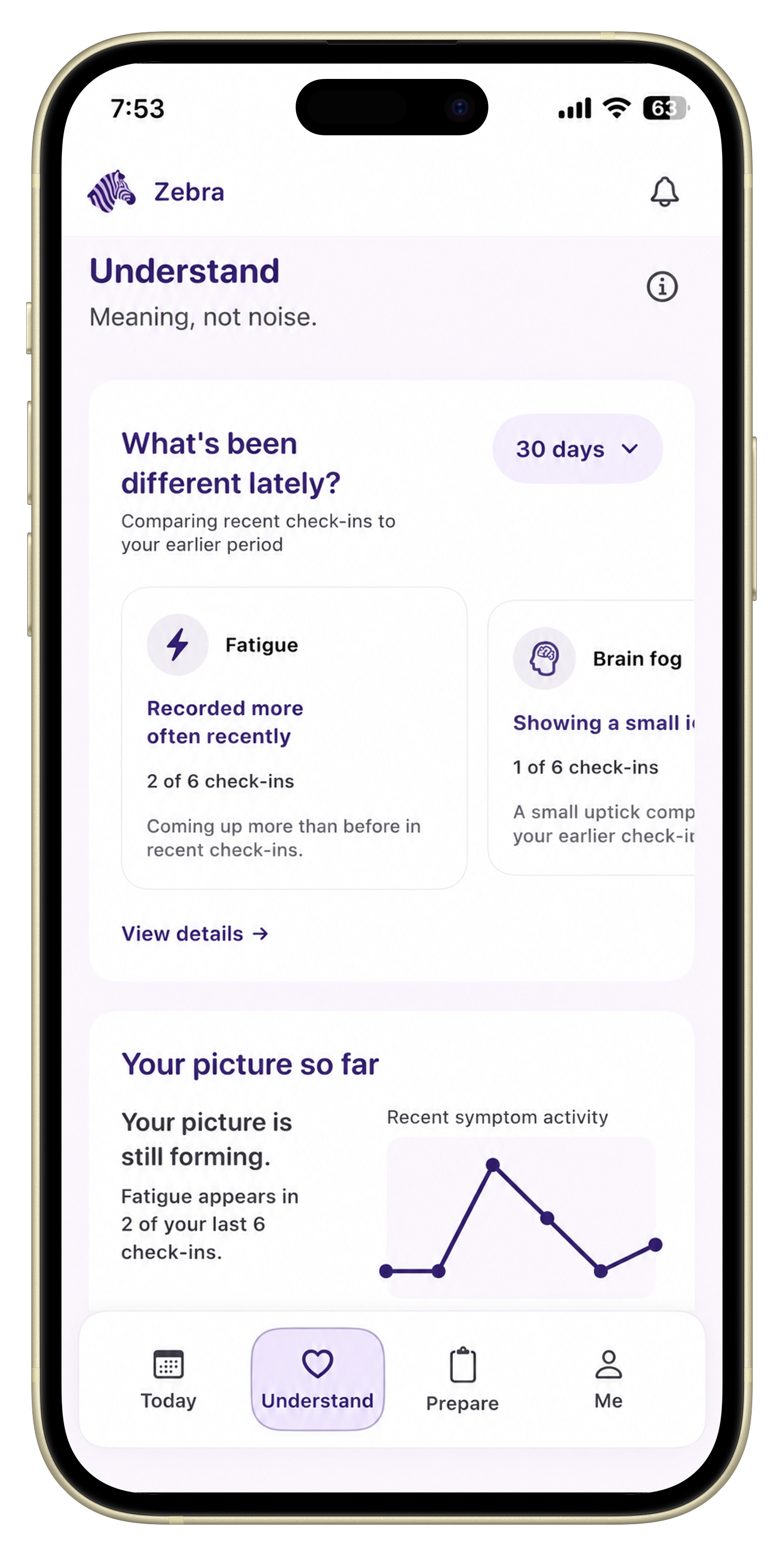
Visible is best understood as a pacing platform. According to Visible’s current product materials, it combines a wearable heart-rate monitor with an app to support pacing through features like a morning stability score, PacePoints, and pacing alerts. Zebra is better understood as a symptom-history and appointment-prep tool that keeps symptoms, flares, medications, orthostatic context, and notes in one record.
So the shortest version is:
Visible is strong if you want:
Visible’s own help materials emphasize pacing, energy envelopes, and continuous heart-rate support as core use cases. That makes it a good fit when the main question is, “How do I avoid overdoing it and crashing?”
Zebra is stronger if you want:
Zebra is built for the point where scattered symptom history becomes hard to explain in a specialist visit.
If your main question is, “How do I stop rebuilding the month from memory before an appointment?” Zebra is the stronger fit.
| Category | Visible | Zebra |
|---|---|---|
| Core approach | Pacing and energy management platform | Symptom-history and appointment-prep tracker |
| Best for | Users focused on pacing, exertion, and crash prevention | Users focused on symptom history, orthostatic context, and doctor visits |
| Daily guidance | Real-time pacing signals and alerts | Structured symptom and context tracking |
| Wearable role | Central to the membership experience | Not the center of the workflow |
| Appointment-prep payoff | Helpful context, but not the core promise | Doctor-ready report and reviewable history are core outcomes |
| Best fit for | Long COVID, ME/CFS, pacing-focused users, and others who need energy management | POTS, dysautonomia, EDS overlap, and people who need cleaner appointment summaries |
That depends on what you are trying to solve.
Visible can still be relevant for POTS or dysautonomia if pacing and exertion management are the main challenges. Its official materials also note that people with POTS and fibromyalgia use the platform, even though its strongest focus is on energy-limiting illness and pacing.
Zebra is the better fit if you are trying to keep:
in one place for later review.
If the real problem is appointment reconstruction, Zebra fits that use case more directly.
For a broader dysautonomia-focused comparison, start with Best Symptom Tracker for Dysautonomia. If you describe the problem as autonomic symptoms rather than dysautonomia, Best App for Autonomic Symptom Tracking is the closer match.
Visible may help if the hardest part is noticing when you are pushing beyond your limit.
Zebra may help more if the hardest part is remembering what happened later.
Those are different types of support:
If you already know your bad days become hard to reconstruct, that usually points toward Zebra. If your main issue is staying inside a sustainable energy range, that usually points toward Visible.
Some people may end up using more than one tool because pacing and appointment preparation are different jobs.
But if your current setup already feels too fragmented, adding another tool only helps if it clearly solves the missing job. A good rule is:
If your bigger problem is still “I have too many disconnected tools,” Zebra is often the better simplification step.
If you are preparing for a cardiology visit specifically, Best App for POTS Cardiology Appointment Prep and Best App for Dysautonomia Cardiology Appointment Prep narrow the choice around appointment outcomes.
Visible is a better fit for pacing-first users who want wearable-guided energy management. Zebra is a better fit for people who need a clearer symptom history, orthostatic context, and a doctor-ready report before appointments.
The better choice is not about which app is “better” in general. It is about which problem is costing you more right now.
Visible is primarily a pacing and energy-management tool, while Zebra is primarily a symptom-history and appointment-prep tracker.
Visible may still be useful for POTS or dysautonomia when pacing and exertion management are your main goals, but it is not built as a full doctor-appointment workflow.
If your main problem is preparing a clearer symptom history and reviewable report before an appointment, Zebra is the stronger fit.
Some people may use different tools for different jobs, but the better choice depends on whether pacing or appointment preparation is the bigger gap in your current system.
Put this into practice
Choose Zebra if you want symptom history, orthostatic context, and a doctor-ready report in one workflow.
Download ZebraKnowledge hub
Keep exploring
A practical comparison of dysautonomia symptom tracker options and what each is best at.
A pillar guide to choosing a symptom tracker for POTS, dysautonomia, EDS, and overlapping chronic illness symptoms.
A practical comparison of Zebra and Bearable for people tracking POTS symptoms and preparing for appointments.
Compare the best symptom tracker apps for POTS in 2026, including Zebra, Bearable, Visible, and Notes-based workarounds.