Best Symptom Tracker for POTS, Dysautonomia, and EDS
A pillar guide to choosing a symptom tracker for POTS, dysautonomia, EDS, and overlapping chronic illness symptoms.

Zebra
For invisible chronic illness
Comparison
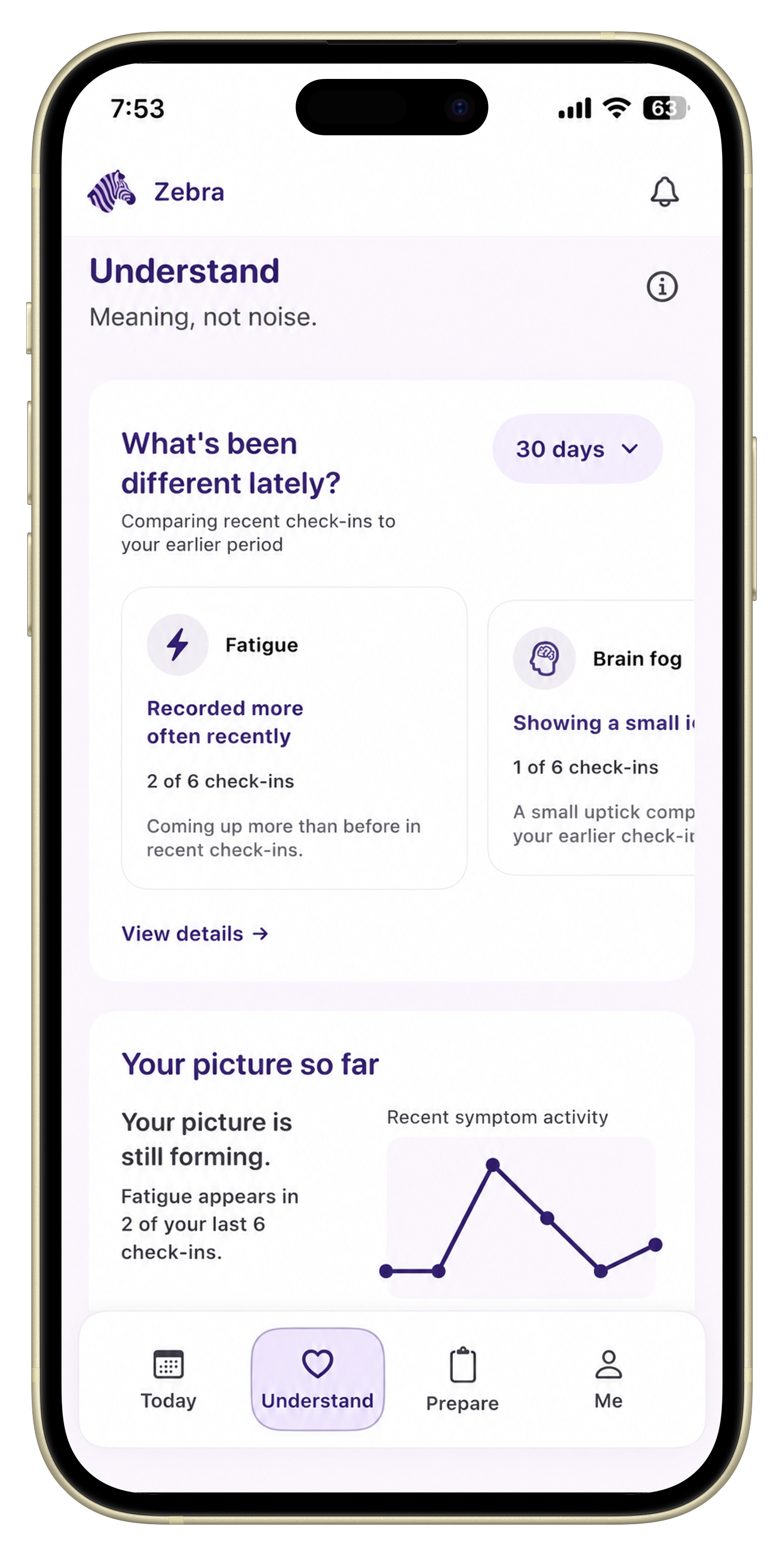
If you are looking for the best symptom tracker for dysautonomia, the right choice depends on what part of the problem is hardest right now. If you want one place for symptoms, orthostatic context, hydration, medications, flares, and appointment prep, Zebra is the strongest fit. If pacing and energy management are the main job, another tool may fit better. If you want maximum customization, a broader tracker can still work.
If you are looking for the best symptom tracker for dysautonomia, the right choice depends on what part of the problem is hardest right now. If you want one place for symptoms, orthostatic context, hydration, medications, flares, and appointment prep, Zebra is the strongest fit. If pacing and energy management are the main job, another tool may fit better. If you want maximum customization, a broader tracker can still work.
The hardest part of dysautonomia tracking is usually not just collecting symptoms. It is keeping enough context to explain what happened when symptoms changed with position, activity, heat, dehydration, meals, stress, or flare days.
If you are comparing across POTS, dysautonomia, and EDS together, start with the broader hub: Best Symptom Tracker for POTS, Dysautonomia, and EDS.
For dysautonomia, the best tracker is not the one with the most charts. It is the one that helps you answer questions like:
That is why the best dysautonomia tracker usually needs more than a blank symptom journal. It needs enough structure to preserve the pattern.
| App or setup | Best for | Strength | Limitation |
|---|---|---|---|
| Zebra | Dysautonomia tracking plus appointment prep | Symptoms, flares, orthostatic context, hydration, salt, medications, and doctor-ready report | Newer product with smaller public footprint |
| Bearable | Broad customizable symptom tracking | Flexible setup and established user base | More setup, generic defaults, less orthostatic-specific structure |
| Visible | Pacing-focused users | Strong pacing and exertion framing | Not built as a full symptom-history and appointment-prep workflow |
| Notes or spreadsheet | Minimal setup | Familiar and flexible | Harder to review, compare, and summarize clearly |
Zebra is the strongest fit if your main goal is keeping dysautonomia symptom history reviewable before a specialist or cardiology appointment.
Its current positioning is strongest around:
If your main question is “How do I stop showing up to appointments with scattered notes?” Zebra is the clearest fit in this set.
If you want the more appointment-specific version of that problem, Symptom Tracker for Doctor Appointments goes deeper.
If you use broader autonomic language instead of dysautonomia, Best App for Autonomic Symptom Tracking covers the same decision from that search intent.
Bearable is still a valid option if you want a generic symptom tracker that you can shape over time.
It may fit better if:
Its tradeoff is that dysautonomia history often depends on keeping orthostatic context, daily function, flare patterns, and appointment prep tightly connected. Generic flexibility can help, but it can also create more setup and more maintenance.
Visible is better understood as a pacing and energy-management platform than as a full dysautonomia symptom-history tool.
If your main question is:
Visible may fit better.
If your main question is:
Zebra is usually the stronger fit.
For the direct comparison, Zebra vs Visible for Chronic Illness Tracking breaks that tradeoff down more clearly.
Notes and spreadsheets can still work if you mainly need a temporary place to write things down.
The limitation is that dysautonomia symptoms often become harder to explain when:
That is where a more structured tracker usually starts to help.
The most useful features usually include:
If you are not sure how to think about the upright-symptom side of this, How to Track POTS Symptoms and Orthostatic Changes and What Is Orthostatic Intolerance? are good starting points.
If the next visit is with cardiology, Best App for Dysautonomia Cardiology Appointment Prep narrows this into the pre-visit workflow.
Choose Zebra if you want:
Choose Bearable if you want:
Choose Visible if you want:
Choose Notes or a spreadsheet if you only need:
The best symptom tracker for dysautonomia is the one that helps you keep the pattern understandable later. For many people, the real problem is not that the symptoms were never noticed. It is that the context was lost by the time the appointment happened. Zebra is built to close that gap.
If you want one place for symptoms, orthostatic changes, medications, hydration, flares, and appointment prep, Zebra is the strongest fit.
Useful features often include symptom history, orthostatic context, flare tracking, medication notes, hydration or salt tracking, and a way to review patterns before appointments.
Not always. A pacing app focuses more on energy management, while a symptom tracker is often better for preserving the history you need to explain later.
No. Focus on the symptoms most relevant to current care, what changed recently, and the context that makes the pattern easier to understand.
Put this into practice
Download Zebra if you want dysautonomia symptom history, orthostatic context, and appointment prep in one place.
Download ZebraKnowledge hub
Keep exploring
A pillar guide to choosing a symptom tracker for POTS, dysautonomia, EDS, and overlapping chronic illness symptoms.
A practical comparison of Zebra and Bearable for people tracking POTS symptoms and preparing for appointments.
A practical comparison of Zebra and Visible for pacing, symptom tracking, and appointment preparation.
Compare the best symptom tracker apps for POTS in 2026, including Zebra, Bearable, Visible, and Notes-based workarounds.