Best App for Autonomic Symptom Tracking
A practical guide to choosing the best app for autonomic symptom tracking and reviewable appointment history.

Zebra
For invisible chronic illness
Comparison
If you need the best symptom tracker for upright intolerance, the most useful choice is the one that keeps symptoms that worsen sitting or standing, position changes, flare context, and daily-function impact in one connected history. If your main problem is explaining the upright pattern later, Zebra is the strongest fit. If you only need a temporary place to note a few observations, simpler tools may still work.
If you need the best symptom tracker for upright intolerance, the most useful choice is the one that keeps symptoms that worsen sitting or standing, position changes, flare context, and daily-function impact in one connected history. If your main problem is explaining the upright pattern later, Zebra is the strongest fit. If you only need a temporary place to note a few observations, simpler tools may still work.
Upright intolerance is patient language many people use when symptoms get worse sitting or standing and ease when lying down. The tracking problem is simple to describe but hard to maintain: the pattern matters, but the details disappear if they are scattered.
The best tracker should help you answer questions like:
That is why upright intolerance tracking works best when symptoms, position, context, and function stay connected.
| App or setup | Best for | Strength | Limitation |
|---|---|---|---|
| Zebra | Upright symptoms plus appointment prep | Keeps symptoms, position context, hydration, meds, flares, function, and report workflow together | Newer product with smaller public footprint |
| Notes or spreadsheet | Temporary capture | Familiar and flexible | Harder to compare patterns and keep context attached |
| Generic symptom tracker | Broad daily tracking | Flexible symptom capture | Position-based structure may require more setup |
| Wearable or pacing tool | Real-time awareness | Useful for continuous feedback | Not the same as a full upright symptom-history workflow |
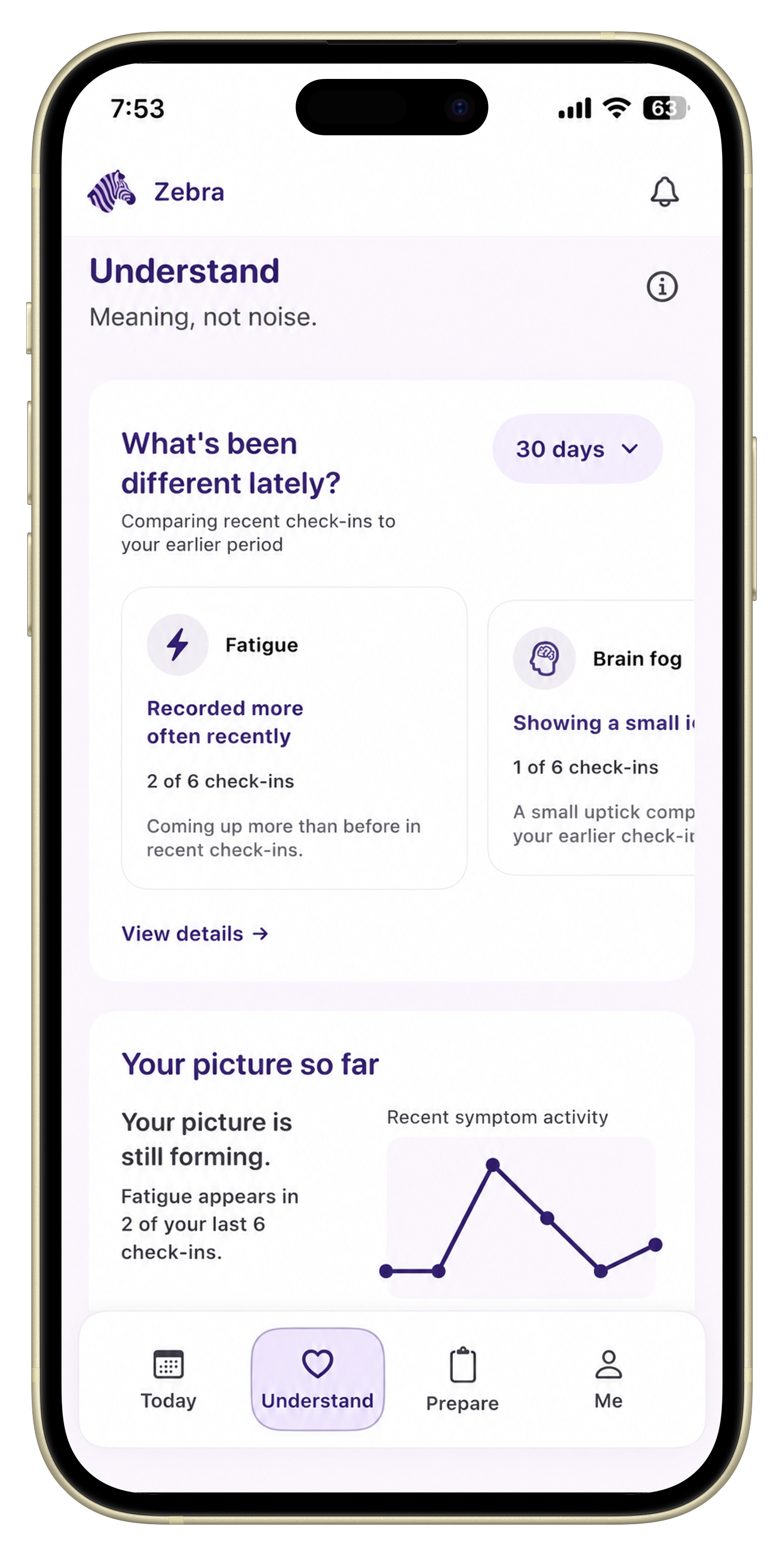
Zebra is the strongest fit if your main goal is keeping upright symptom history understandable before appointments.
Its current fit is strongest when you want:
If your main problem is “I know upright symptoms matter, but I cannot explain the whole pattern later,” Zebra fits that problem directly.
Upright intolerance and orthostatic intolerance often point to a similar lived pattern, but people search for them differently.
Orthostatic intolerance is the more formal phrase. Upright intolerance is often the plain-language version someone uses when they know standing or sitting upright makes symptoms worse.
For the more formal version, Best Symptom Tracker for Orthostatic Intolerance is the closest companion page. For a simple definition, start with What Is Orthostatic Intolerance?.
If you are tracking POTS symptoms specifically, Best App for Orthostatic Symptom Tracking and How to Track POTS Symptoms and Orthostatic Changes are the stronger POTS-focused companions.
The most useful tracker usually includes:
If the next step is turning this into a visit summary, What Is a Doctor-Ready Symptom Report? explains the output Zebra is designed around.
The best symptom tracker for upright intolerance is the one that keeps position-related symptom changes understandable later. For many people, the missing piece is not more logging. It is one connected history that makes the upright pattern easier to review and discuss. Zebra is built to close that gap.
If you want symptoms that worsen sitting or standing, position changes, flare context, and appointment prep in one place, Zebra is the strongest fit.
People often use upright intolerance to describe a similar lived pattern: symptoms that appear or worsen while upright and improve when lying down.
Track the symptoms that worsen upright, position notes, relevant measurements when useful, flare context, daily-function changes, and questions for appointments.
No. Focus on the clearest pattern, recent changes, and the context that helps you explain what happens when upright.
Put this into practice
Download Zebra if you want upright symptoms and appointment prep in one connected history.
Download ZebraKnowledge hub
Keep exploring
A practical guide to choosing the best app for autonomic symptom tracking and reviewable appointment history.
A practical guide to choosing an app for orthostatic symptom tracking and reviewable appointment history.
A practical comparison of dysautonomia symptom tracker options and what each is best at.
A practical guide to choosing the best symptom tracker for orthostatic intolerance.