Symptom Tracker for Doctor Appointments
A practical guide to choosing a symptom tracker that helps before specialist and follow-up appointments.

Zebra
For invisible chronic illness
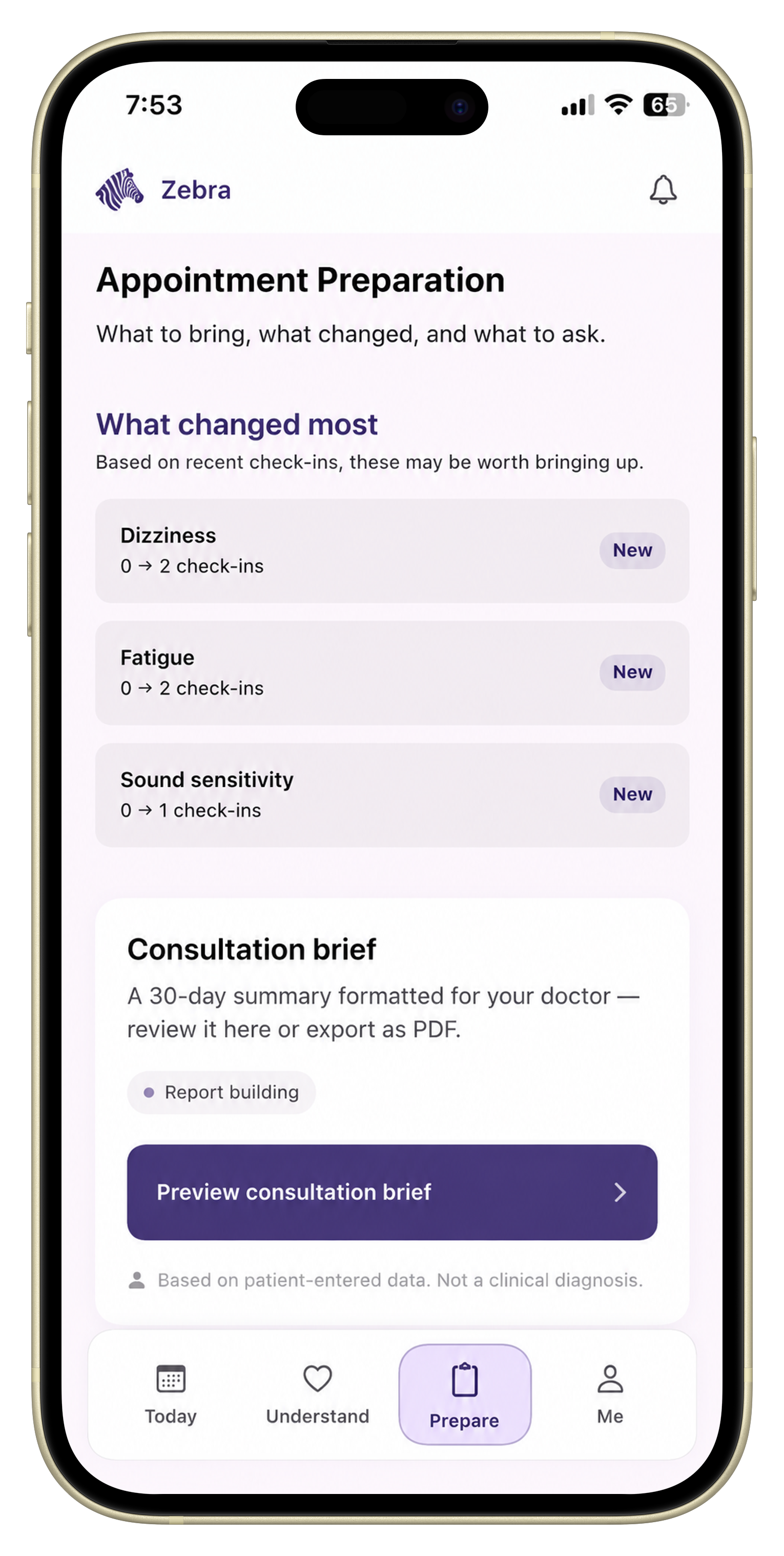
Appointment Preparation
A doctor appointment symptom checklist helps you bring the right details without trying to remember your whole health history in the waiting room. The most useful checklist includes your main symptoms, what changed, flare patterns, functional impact, medications, relevant measurements, and the top questions you need answered.
A doctor appointment symptom checklist helps you bring the right details without trying to remember your whole health history in the waiting room. The most useful checklist includes your main symptoms, what changed, flare patterns, functional impact, medications, relevant measurements, and the top questions you need answered.
The goal is not to arrive with perfect records. The goal is to make the appointment easier to use.
This matters for chronic illness because symptoms often change slowly, overlap, or blur together during flare days. By the time you sit down with a clinician, it can be hard to remember what happened this week, what happened last month, and what you wanted to ask.
Before your appointment, try to bring:
You do not need every detail. You need the details that help the visit move from vague memory to a clearer conversation.
Start with the symptoms that are most relevant to the appointment.
For many Zebra users, that may include:
Choose symptoms that are new, worse, repeated, or affecting daily life most. If you list twenty symptoms, the most important ones can get lost. If you choose three to five, the conversation has a center.
MedlinePlus recommends writing down symptom details before a visit, including what symptoms are, when they appear, how long they have been happening, and whether they have changed. See Make the most of your doctor visit.
Doctors often need the change, not just the symptom name.
Write down:
For chronic illness, “I am tired” may be true but hard to act on. “Fatigue changed from mostly evenings to all day after short activity” gives the appointment more context.
If symptoms come in waves, add a short flare section.
Useful flare notes include:
You do not need to prove a trigger. It is enough to say, “These things happened near the flare.”
For more detail, How to Track Medication Changes During a Flare and How to Track Salt, Fluids, and Flares cover related patterns.
Functional impact is the part many people forget, but it can make symptom notes much clearer.
Write down what symptoms changed in real life:
This helps translate symptoms into daily consequences. A symptom name tells what you felt. Functional impact shows what it cost.
Bring a current list of:
AHRQ advises patients to bring all medicines, including prescription medicines, non-prescription medicines, vitamins, and dietary or herbal supplements, and to write down questions before an appointment. See Be More Engaged in Your Healthcare.
If your appointment is about dizziness, palpitations, fatigue, POTS, dysautonomia, EDS, fibromyalgia, Long COVID, or overlapping symptoms, medication and routine context can help the clinician understand what changed around the same period.
Only include measurements that are relevant to the visit.
Examples:
For POTS or dysautonomia-related appointments, position-based heart rate or blood pressure observations may be useful discussion context. For other appointments, measurements may be less important than symptom timing, functional impact, and medication history.
The checklist should help the visit, not bury it in numbers.
Write the questions before the visit.
AHRQ’s patient materials suggest bringing your top questions and asking about medicines, tests, treatment options, side effects, interactions, alternatives, and next steps. See The 10 Questions You Should Know.
Useful question formats:
If you have more than three questions, mark the most important ones first. Short appointments move quickly.
If you only have ten minutes, use this:
The main thing I need help with is:
This is enough to make the appointment more focused.
Zebra is built for people who need symptom notes to become appointment-ready, not just stored.
Use Zebra to keep:
in one place, so the appointment does not depend on memory alone.
For the broader prep workflow, read How to Track Symptoms Before a Specialist Appointment. For the summary format, read How to Prepare a Monthly Symptom Summary.
A good doctor appointment symptom checklist is short, specific, and easy to review. It should answer what changed, what repeated, what affected daily life, what medicines or routines changed, and what you need help deciding next.
You are not trying to bring a perfect diary. You are trying to bring the clearest starting point for the conversation.
Write down the symptoms most relevant to the visit, especially symptoms that are new, worse, frequent, disruptive, or connected to the reason for the appointment.
Bring a short symptom summary, medication and supplement list, recent changes, relevant measurements, major flare notes, functional impact examples, and your top questions.
Keep it short enough to scan during the visit. One page or a few organized sections is usually more useful than a long diary.
Yes. A clear list of prescriptions, over-the-counter medicines, vitamins, and supplements is useful appointment context.
No. This checklist is an organization tool for appointment preparation. It does not diagnose, treat, or replace medical care.
Put this into practice
Use Zebra to keep symptoms, flares, medications, measurements, and appointment questions in one doctor-ready history.
Download ZebraKnowledge hub
Keep exploring
A practical guide to choosing a symptom tracker that helps before specialist and follow-up appointments.
Learn what to track before a specialist appointment, including symptoms, flares, medications, function changes, and your top questions.
Learn how to organize symptom history, medications, function changes, and questions into a clear doctor-visit summary.
A practical framework for tracking how symptoms affect daily life before a doctor appointment.