Doctor Appointment Symptom Checklist
A practical symptom checklist for preparing clearer notes before a doctor, specialist, or cardiology appointment.

Zebra
For invisible chronic illness
Appointment Preparation
If you have a specialist appointment coming up, the most useful thing to track is not everything that has ever happened. It is the recent symptom history that helps you explain what changed, what is affecting daily life, what you have tried, and what questions you need answered. The goal is to walk in with a clear picture, not a perfect diary.
If you have a specialist appointment coming up, the most useful thing to track is not everything that has ever happened. It is the recent symptom history that helps you explain what changed, what is affecting daily life, what you have tried, and what questions you need answered. The goal is to walk in with a clear picture, not a perfect diary.
For many people with chronic illness, the hardest part is not noticing symptoms. It is remembering them clearly when the appointment actually happens. Brain fog, flare days, and scattered notes across different apps make it easy to forget the details that matter most. A simple structure helps more than tracking more.
A useful symptom history helps your clinician understand four things quickly:
That means your tracking should focus on patterns and decision-making context, not on writing a long narrative for every day.
For people managing POTS, dysautonomia, EDS, fibromyalgia, or overlapping conditions, the appointment problem is often the same: you have plenty of lived experience, but it is hard to turn that experience into a short, organized summary when you are already tired, dizzy, foggy, or rushed.
Start with the symptoms that are most relevant to the appointment you are about to have.
Examples:
You do not need to track every sensation. Track the symptoms that are:
If you only have energy to track a few things, start there.
Your specialist does not just need a symptom name. They need timing and change.
Track:
This is especially useful for fluctuating conditions, where “I feel bad sometimes” is true but too broad to help much in a short appointment.
For POTS and dysautonomia-related symptoms, it can be especially helpful to note whether symptoms worsen when upright and improve when lying down, since orthostatic symptoms are often position-related. Dysautonomia International notes that POTS symptoms commonly include lightheadedness, fatigue, palpitations, and exercise intolerance, and that bedside heart rate and blood pressure observations may be part of evaluation conversations for some patients. See Dysautonomia International.
If your symptoms come in waves, track the flares rather than trying to recreate every single hour.
Useful flare details include:
This gives you a clearer picture of the bad days your brain is most likely to blur together later.
This is one of the most overlooked parts of appointment prep.
Track what symptoms actually stopped you from doing.
Examples:
This matters because symptoms are easier to dismiss when they are described only as words. Functional impact shows what those symptoms are doing to your day-to-day life.
Bring a clean list of what you are taking and note anything that changed recently.
That includes:
The Agency for Healthcare Research and Quality recommends keeping a list of medicines, vitamins, and supplements and showing that list to your clinician. See Your Medicine: Be Smart. Be Safe..
You do not need a perfect medication spreadsheet. You do need a list that is easy to review.
Only track numbers that are relevant to the reason for the visit or that your clinician has already asked about.
Examples:
For a cardiology or dysautonomia-related visit, position-based observations may be useful context. For another type of appointment, detailed vitals may matter less than symptoms and functional impact.
The point is not to overwhelm your specialist with numbers. The point is to bring the numbers that help explain your history.
A lot of people prepare symptom notes and forget to prepare the questions they most need answered.
Before the appointment, write down the top two or three things you want to ask.
The AHRQ Questions Are the Answer materials recommend writing down your top questions before the visit and bringing them with you. See My Questions for This Visit and Do You Know the Right Questions to Ask?.
Good question categories include:
If you leave with your questions unanswered, even a well-tracked appointment can still feel incomplete.
If you are short on energy, use this structure:
This is enough for a strong appointment summary even if you are not tracking perfectly.
For most specialist visits, the most useful place to start is the recent window leading up to the appointment.
A practical default is:
You do not need to rebuild your entire health story from scratch the night before.
What matters most is:
Do not turn this into a perfection project.
You usually do not need:
If tracking takes so much energy that you stop doing it, it is too much.
On brain fog days, aim for the smallest version that still helps later.
That might be:
That is still useful.
The goal is not “track everything well.” The goal is “leave future you something real to work with.”
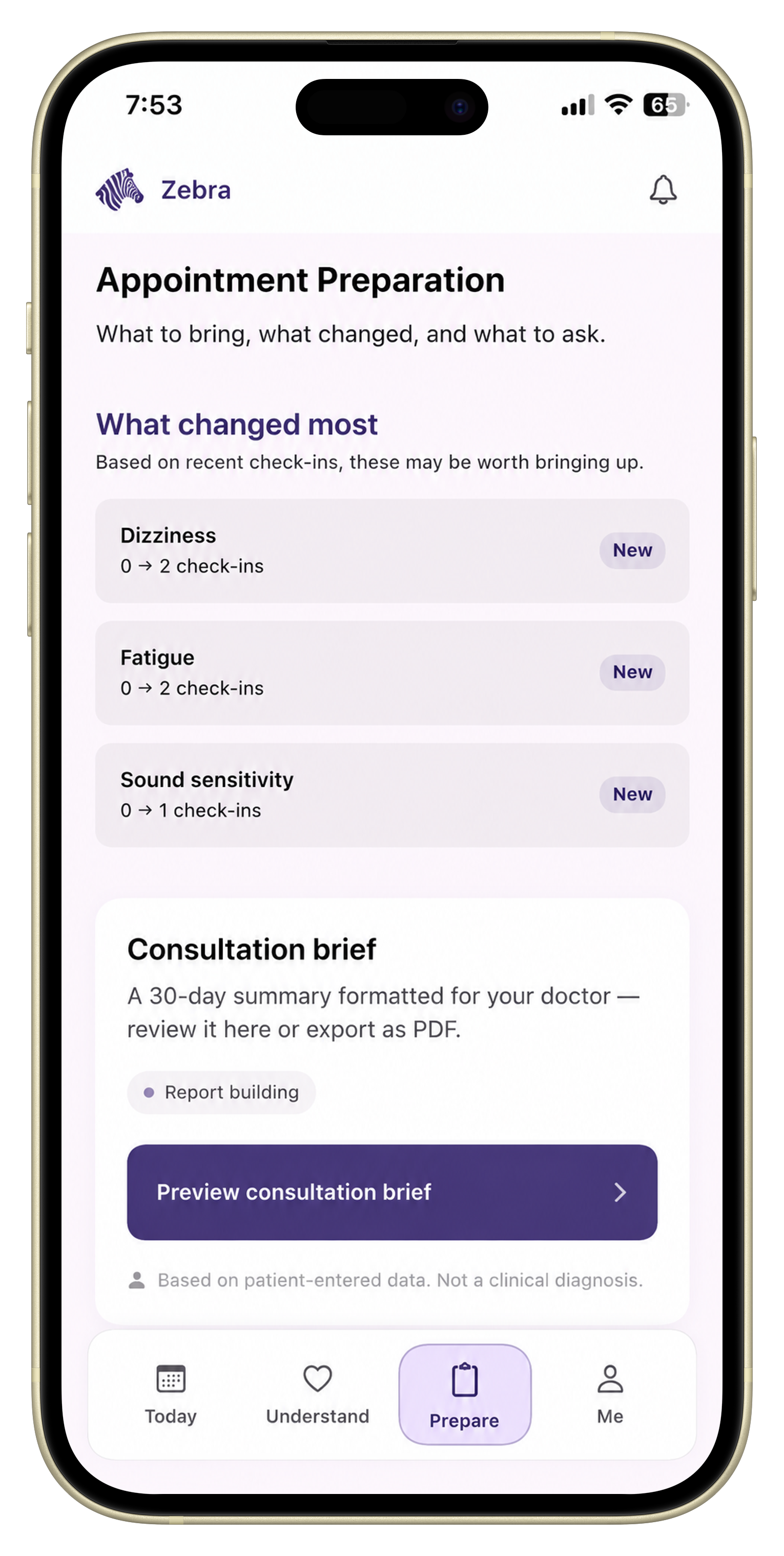
Zebra is built for this exact appointment-prep problem.
Instead of keeping symptoms in one place, meds in another, and questions in your head, Zebra can help you keep:
in one patient-entered history.
That history can then become a doctor-ready report you can review before the visit instead of trying to reconstruct everything from memory while symptomatic.
Zebra does not diagnose conditions or tell you what your specialist will decide. It helps organize what you tracked so the appointment is easier to prepare for.
If the appointment is already on the calendar, start with simple tracking now. Even a few days of organized notes are better than a rushed summary from memory.
More data is not always more useful. Track what is most relevant to the visit.
If you only track symptom names, you may miss the part that shows why the symptom matters.
Clinicians often need the treatment context as much as the symptom context.
Questions are part of appointment prep, not an optional extra.
Track your main symptoms, when they happen, what changed, flare patterns, functional impact, medication or supplement changes, relevant home measurements, and your top questions for the visit.
If the appointment is soon, start now. A practical default is to focus on the last 2 to 4 weeks, plus any older changes that are especially important or repeated.
No. Track the symptoms that are most disruptive, most relevant to the visit, or clearly new or worse.
Yes. A clean list of medicines, supplements, and recent changes is often useful context and can prevent you from forgetting key details during the visit.
Use the minimum useful version: one symptom, one severity note, one change, and one line about how it affected your day. A small real record is better than no record.
It may help to note position-related symptoms, recent flares, hydration and salt changes, and any home heart rate or blood pressure observations relevant to the visit. Keep the notes simple and discussion-focused.
Put this into practice
Download Zebra to keep symptoms, function changes, medications, and appointment questions in one doctor-ready history.
Download ZebraKnowledge hub
Keep exploring
A practical symptom checklist for preparing clearer notes before a doctor, specialist, or cardiology appointment.
A practical guide to choosing a symptom tracker that helps before specialist and follow-up appointments.
Learn how to organize symptom history, medications, function changes, and questions into a clear doctor-visit summary.
A practical framework for tracking how symptoms affect daily life before a doctor appointment.