Travel Day Symptom Tracker for POTS: What to Log
A practical guide to tracking POTS symptoms during flights, car rides, terminals, lines, missed meals, hydration changes, salt, compression, medication timing, fatigue, recovery, and travel planning.

Zebra
For invisible chronic illness
Dysautonomia
Standing-still notes are most useful when time upright, movement, heat, hydration, salt, meals, compression, heart rate, dizziness, palpitations, blood pooling, recovery, and functional impact stay connected. The goal is not to prove every line is unsafe. The goal is to bring clearer prolonged-standing patterns to your clinician.
For many people with POTS, dysautonomia, orthostatic intolerance, Long COVID, EDS or HSD overlap, ME/CFS, or chronic illness, standing still can be harder than walking. A checkout line, pharmacy wait, bus stop, concert queue, security line, school hallway, kitchen counter, or clinic waiting room can bring dizziness, racing heart, nausea, shakiness, heavy legs, brain fog, sweating, blood pooling, or near-fainting.
A standing-in-line symptom tracker does not diagnose POTS, dysautonomia, low blood pressure, dehydration, anxiety, or any other condition. It helps you bring a clearer prolonged-standing pattern to a clinician: what the standing situation was, how long it lasted, what symptoms appeared, what helped, and what changed in your day.
The most useful note is often simple: where you were, what you were doing, and how long you were upright.
Track:
Example: “Grocery line, standing still 12 minutes after 25 minutes shopping. Warm store. Dizziness 6/10, heart racing, legs heavy. Sat in car with water; improved after 20 minutes.”
That kind of note is easier to discuss than “shopping wiped me out.”
Some people tolerate slow walking better than standing still. Others flare with both.
Useful distinctions:
This helps your clinician see whether the issue is mainly time upright, stillness, heat, exertion, meals, or a combination.
Write when symptoms started and what changed first.
Track whether you noticed:
If you already measure heart rate or blood pressure as part of your care plan, add position and timing: before standing, while standing, after sitting, or after lying down. Do not measure in public if it is unsafe or makes symptoms worse.
Standing symptoms can change depending on context.
Useful notes:
Do not change fluids, salt, compression, or medication based on a tracker alone. Use the pattern to ask better questions.
Track what reduced symptoms or helped you finish the task.
Examples:
The point is not to judge the strategy. The point is to learn what makes daily life safer and more realistic.
Recovery is part of the episode.
Write:
“Felt better after sitting for 5 minutes” and “lost the rest of the afternoon” are different clinical details.
Before a primary care, cardiology, neurology, dysautonomia, Long COVID, EDS, or rehabilitation appointment, summarize:
Useful questions:
Helpful background:
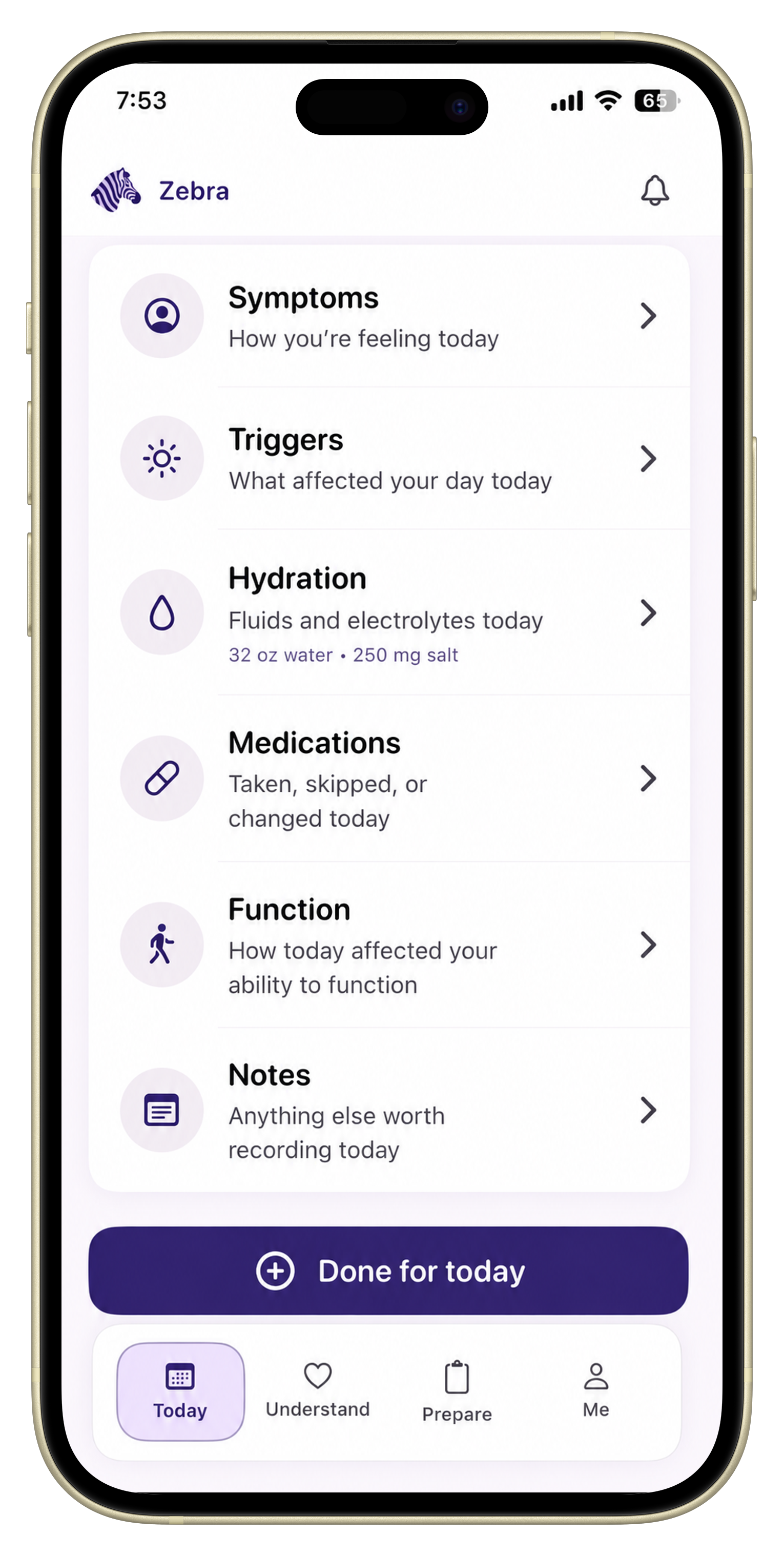
Zebra helps keep standing episodes, symptoms, hydration, salt, compression, medications, recovery, and appointment questions in one timeline.
It does not diagnose POTS or autonomic conditions. It helps you bring a clearer, doctor-ready standing pattern to the clinician who can evaluate it.
Put this into practice
Use Zebra to keep standing episodes, heat, hydration, salt, compression, symptoms, recovery, and appointment questions in one timeline.
Download ZebraKnowledge hub
Keep exploring
A practical guide to tracking POTS symptoms during flights, car rides, terminals, lines, missed meals, hydration changes, salt, compression, medication timing, fatigue, recovery, and travel planning.
A practical guide to tracking sick-day POTS flares, infection symptoms, fever, hydration, salt, medication timing, heart rate, dizziness, fatigue, recovery, and doctor-ready summaries.
A practical guide to tracking morning POTS symptoms, getting out of bed, hydration, salt, breakfast, medication timing, heart rate, blood pressure, dizziness, brain fog, recovery, and doctor-ready summaries.
A practical guide to tracking blood pooling, leg or foot discoloration, swelling, heaviness, pain, standing time, posture, compression, hydration, salt, recovery, and appointment summaries.