Illness and Infection POTS Flare Tracker: What to Log
A practical guide to tracking sick-day POTS flares, infection symptoms, fever, hydration, salt, medication timing, heart rate, dizziness, fatigue, recovery, and doctor-ready summaries.

Zebra
For invisible chronic illness
Dysautonomia
Morning symptom notes are most useful when wake time, sleep, first position change, fluids, salt, breakfast, medication timing, heart rate, blood pressure, dizziness, palpitations, brain fog, recovery, and functional impact stay connected. The goal is not to prove mornings are the only problem. The goal is to bring clearer first-hour patterns to your clinician.
Some people with POTS, dysautonomia, orthostatic intolerance, Long COVID, EDS or HSD overlap, ME/CFS, migraine, or chronic illness notice that mornings are harder than the rest of the day. Getting out of bed may bring dizziness, racing heart, nausea, shakiness, weakness, brain fog, sweating, headache, or a need to sit back down.
A morning POTS symptom tracker does not diagnose POTS, dysautonomia, low blood pressure, dehydration, sleep disorders, medication effects, or any other condition. It helps you bring a clearer first-hour pattern to a clinician: what happened after waking, what changed the symptoms, and how much of the morning was affected.
Morning notes are more useful when they include the night before.
Track:
Example: “Woke 7:20 after 5 hours broken sleep. Dizzy before standing, brain fog 6/10. Symptoms worsened after walking to bathroom.”
That is easier to review than “bad morning.”
For POTS and orthostatic intolerance, the shift from lying down to sitting or standing can matter.
Record:
If you already track heart rate or blood pressure as part of your care plan, add timing and position: lying before getting up, sitting, standing, or after walking. Do not start intensive monitoring if it is unsafe or makes anxiety worse; ask your clinician what is useful.
Morning symptoms can sit inside a larger context.
Useful notes:
Do not change fluids, salt, meals, medications, or supplements based on a tracker alone. Use the pattern to ask better questions.
Write the symptoms that actually changed your morning, not every sensation.
Common morning notes may include:
If symptoms are new, severe, one-sided, or different from your usual pattern, follow your clinician’s guidance about urgent care.
Tracking improvement is just as useful as tracking symptoms.
Note whether you tried:
This can turn a vague pattern into practical appointment questions.
Morning symptoms matter because they change what you can do.
Record whether symptoms affected:
“Needed 20 minutes before work” and “missed work because I could not stay upright” are very different patterns.
Before a primary care, cardiology, neurology, Long COVID, EDS, dysautonomia, or rehabilitation appointment, summarize:
Useful questions:
Helpful background:
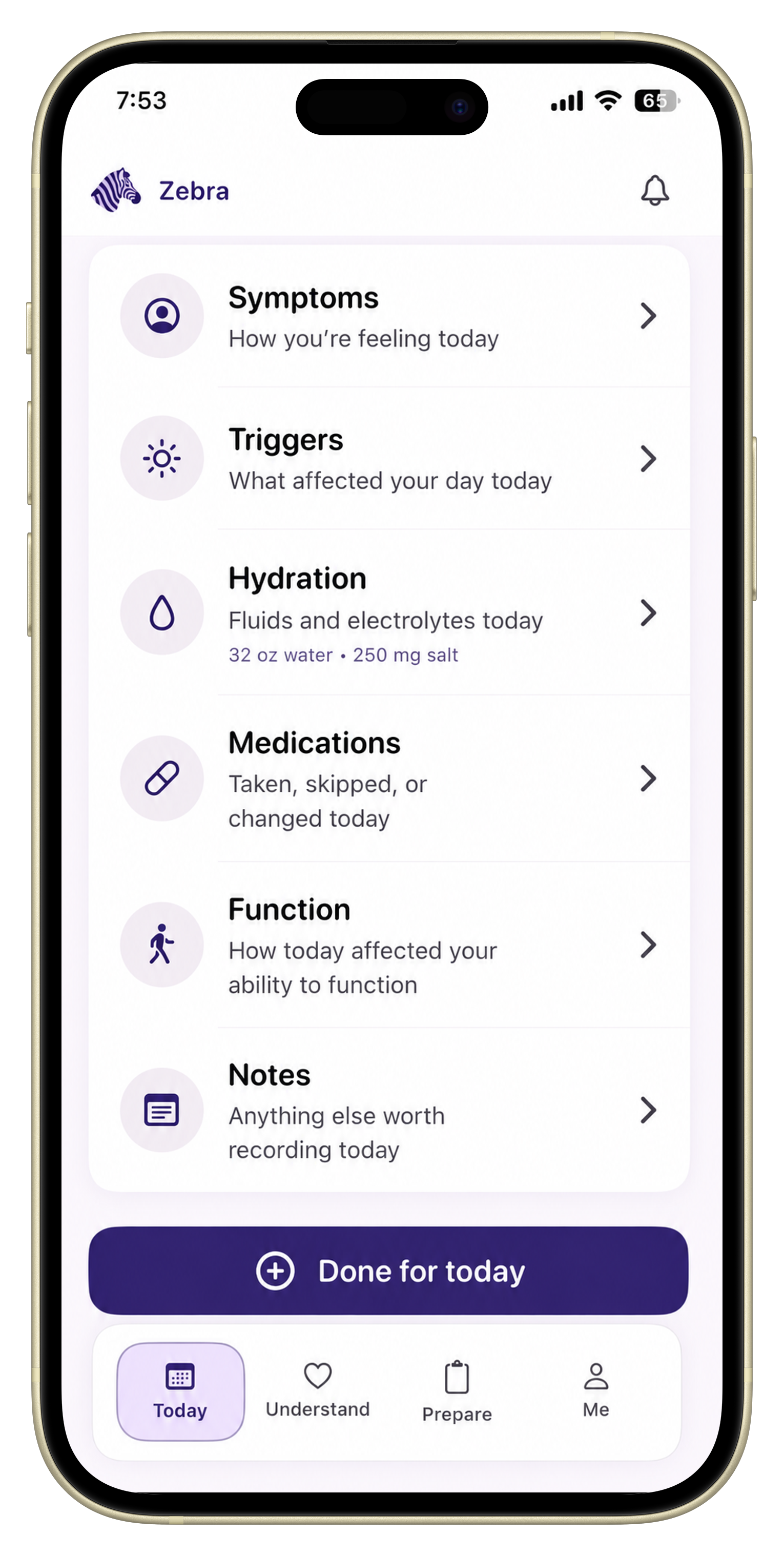
Zebra helps keep morning symptoms, sleep, first standing, fluids, salt, meals, medication timing, recovery, and appointment questions in one timeline.
It does not diagnose morning POTS symptoms or autonomic conditions. It helps you bring a clearer, doctor-ready morning pattern to the clinician who can evaluate it.
Put this into practice
Use Zebra to keep morning symptoms, sleep, first standing, fluids, salt, medication timing, recovery, and appointment questions in one timeline.
Download ZebraKnowledge hub
Keep exploring
A practical guide to tracking sick-day POTS flares, infection symptoms, fever, hydration, salt, medication timing, heart rate, dizziness, fatigue, recovery, and doctor-ready summaries.
A practical guide to tracking POTS symptoms during flights, car rides, terminals, lines, missed meals, hydration changes, salt, compression, medication timing, fatigue, recovery, and travel planning.
A practical guide to tracking shower and bath symptoms, water temperature, standing time, sitting support, dizziness, heart rate, palpitations, nausea, sweating, recovery, and appointment summaries.
A practical guide to tracking symptoms while standing in line, shopping, waiting, commuting, hydration, salt, compression, heart rate, dizziness, palpitations, recovery, and doctor-ready summaries.