
What to Track After a Positive Tilt Table Test
A practical guide to tracking symptoms and context after a positive tilt table test for clearer follow-up appointments.

Zebra
For invisible chronic illness
POTS
Home orthostatic notes are most useful when numbers stay connected to posture, timing, symptoms, medications, hydration, and safety context. The goal is not to diagnose yourself. The goal is to bring clearer observations to your clinician.
Home notes for POTS or orthostatic intolerance are most useful when heart rate and blood pressure stay connected to posture, timing, symptoms, and context.
Numbers alone can be misleading. A heart rate value without “lying, standing, minute 2, dizzy, had taken medication” is much less useful than a simple timeline. The goal is not to diagnose yourself at home. The goal is to bring clearer observations to your clinician.
Do not do a home standing check if your clinician has told you not to, if you are alone and prone to fainting, or if you feel unsafe.
Stop and sit or lie down if you feel:
Home tracking should never be more important than staying safe.
The setup explains why two days can look different.
Write down:
The Heart Rhythm Society consensus statement notes that POTS symptoms happen with standing and commonly include lightheadedness, palpitations, tremor, weakness, blurred vision, exercise intolerance, and fatigue. Context helps your clinician decide what the numbers mean.
For each reading, connect the number to posture and time.
Useful labels include:
The American College of Cardiology describes a 10-minute active stand test as measurements after being supine, immediately on standing, and at 2, 5, and 10 minutes. Bateman Horne Center’s NASA 10 Minute Lean Test uses repeated pulse and blood pressure readings with symptom observation. Your clinician can tell you which format is appropriate for you.
Heart rate without blood pressure can miss part of the story. Blood pressure without symptoms can also be hard to interpret.
For each time point, record:
Example:
| Time | Position | HR | BP | Symptoms |
|---|---|---|---|---|
| Baseline | Lying | 72 | 112/70 | 1/10, calm |
| Minute 2 | Standing | 112 | 110/72 | 5/10 dizzy, shaky |
| Minute 5 | Standing | 123 | 108/70 | 7/10 palpitations, fog |
| Recovery | Lying | 82 | 114/72 | improving after 4 minutes |
This kind of note is much easier to review than a list of disconnected readings.
Orthostatic notes are about how the body responds to posture, not just what the monitor says.
Track symptoms like:
If symptoms improve after lying down, write that down too.
Major consensus sources describe POTS using a sustained heart rate increase with standing, symptoms of orthostatic intolerance, and no significant orthostatic hypotension. They also emphasize clinical interpretation and excluding other causes such as dehydration, infection, anemia, fever, pain, thyroid disease, medication effects, or prolonged bed rest.
So your home note should not say “I diagnosed myself.”
It can say:
“I tracked several standing episodes. Symptoms appeared while upright, heart rate increased, and symptoms improved after lying down. Can we review whether this fits POTS, orthostatic hypotension, vasovagal syncope, another dysautonomia pattern, or something else?”
That is a stronger appointment question.
Formal notes are useful, but daily-life episodes matter.
Record when symptoms happen during:
For each episode, write:
Use this when you want a structured note:
Short, consistent notes are more useful than trying to collect perfect data once.
Helpful background:
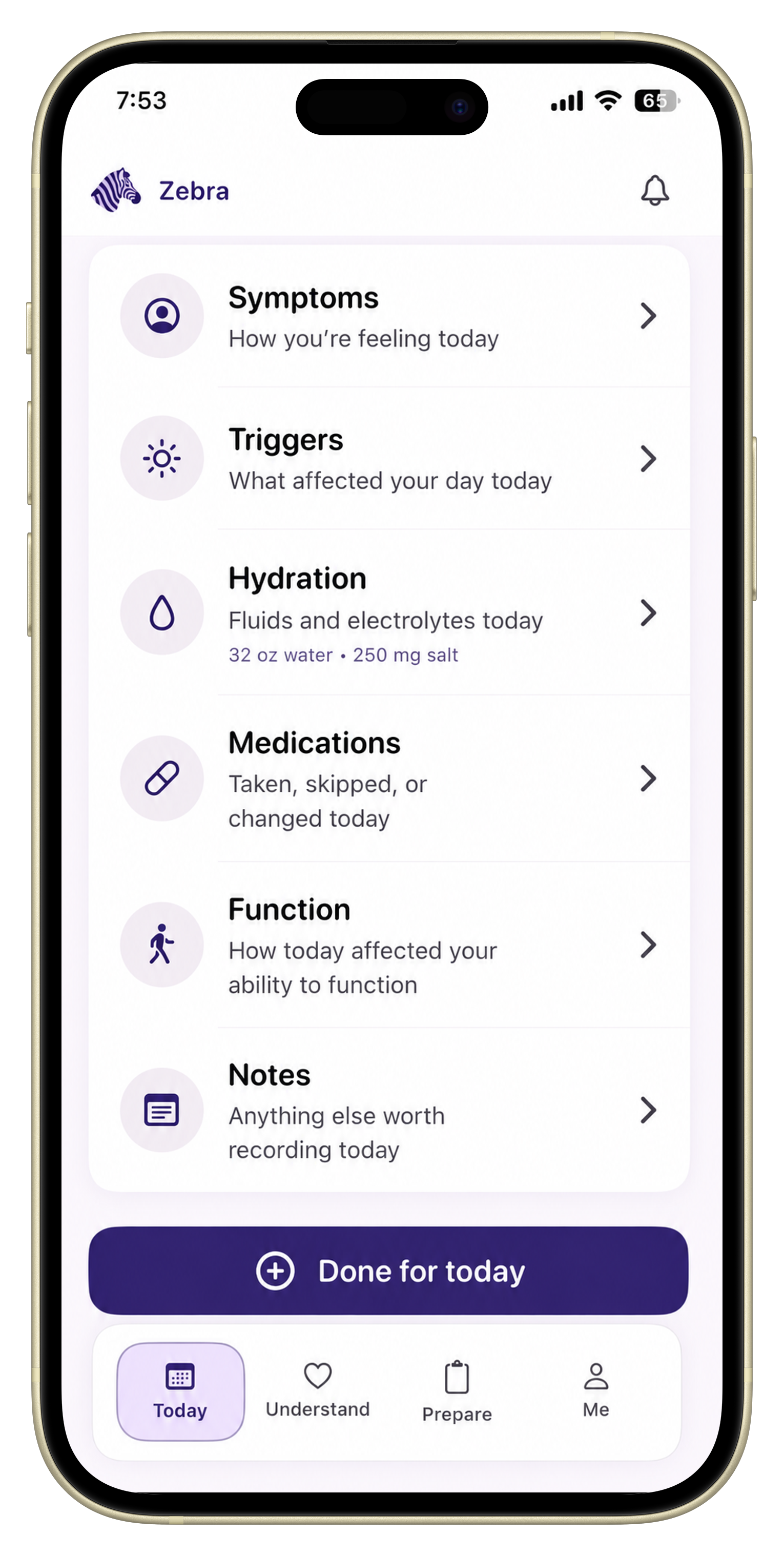
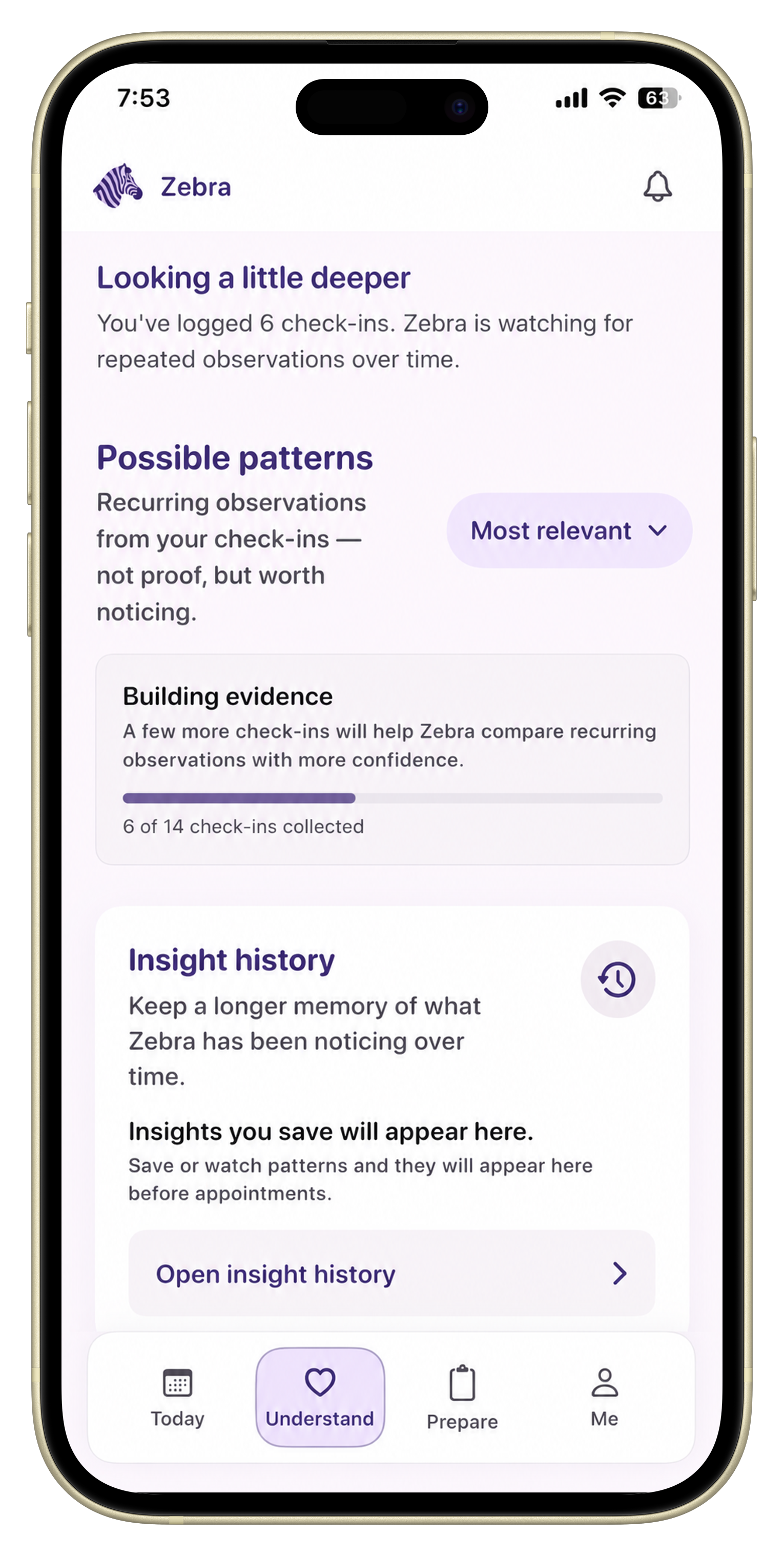
Zebra helps keep orthostatic test notes, symptoms, heart rate, blood pressure, medications, hydration, salt context, triggers, and appointment questions in one place.
It does not diagnose POTS or interpret your readings. It helps you bring a clearer record to the person who can.
Record posture, time, heart rate, blood pressure, symptoms, whether symptoms improved after sitting or lying down, medication context, hydration, salt if relevant to your care plan, and safety notes.
No. Home notes can support a clinician conversation, but POTS diagnosis requires clinical interpretation and ruling out other causes of tachycardia or orthostatic symptoms.
Stop if you feel unsafe, faint, develop severe symptoms, or your clinician told you to stop under certain conditions. Sit or lie down and seek medical help when symptoms are concerning.
No. Do not change treatment based on home readings alone. Use the notes to ask your clinician what changes are appropriate for you.
No. Zebra helps organize patient-entered history for appointments. It does not diagnose, treat, or replace medical care.
Put this into practice
Use Zebra to keep orthostatic notes, symptoms, vitals, hydration, medications, and appointment questions in one timeline.
Download ZebraKnowledge hub
Keep exploring
A practical guide to tracking symptoms and context after a positive tilt table test for clearer follow-up appointments.
A practical guide to tracking sick-day POTS flares, infection symptoms, fever, hydration, salt, medication timing, heart rate, dizziness, fatigue, recovery, and doctor-ready summaries.
A practical guide to tracking morning POTS symptoms, getting out of bed, hydration, salt, breakfast, medication timing, heart rate, blood pressure, dizziness, brain fog, recovery, and doctor-ready summaries.
A practical guide to tracking palpitations, racing heart, skipped beats, heart rate, posture, dizziness, triggers, medication context, recovery, and appointment-ready summaries.