
How to Track Pre-Syncope and Weird Dysautonomia Episodes
A practical guide to tracking near-fainting, lightheadedness, and strange dysautonomia episodes without relying on memory.

Zebra
For invisible chronic illness
Dysautonomia
Orthostatic hypotension notes are most useful when blood pressure, heart rate, posture, symptoms, timing, meals, medications, and recovery are kept together. The goal is not to diagnose yourself. The goal is to bring clearer standing-related patterns to your clinician.
Orthostatic hypotension means blood pressure drops after standing. For many people, the noticeable part is not the number itself. It is the moment when standing brings dizziness, lightheadedness, weakness, blurred vision, nausea, confusion, or feeling close to fainting.
A useful home note connects the reading to the situation: posture, timing, symptoms, meals, medication timing, hydration, and recovery. That context helps your clinician review whether the pattern looks like orthostatic hypotension, POTS, vasovagal syncope, medication effects, dehydration, another dysautonomia pattern, or something else.
Home tracking is not a diagnosis. It is a clearer memory aid.
Do not do a standing check at home if your clinician told you not to, if you are alone and prone to fainting, or if you feel unsafe.
Stop and sit or lie down if you feel:
If symptoms are concerning, seek medical help. Tracking should never push you to continue standing when your body is telling you to stop.
Blood pressure changes only make sense when the posture is clear.
Useful labels include:
Several clinical sources describe orthostatic blood pressure checks using lying or supine readings followed by standing readings. Some recommendations also mention repeated measurements across different days when the pattern is not obvious in one visit.
For each time point, record:
Example:
| Time | Position | BP | HR | Symptoms |
|---|---|---|---|---|
| Baseline | Lying | 118/72 | 68 | 1/10, calm |
| Minute 1 | Standing | 96/64 | 76 | 5/10 dizzy, weak |
| Minute 3 | Standing | 92/60 | 78 | 7/10 blurry vision |
| Recovery | Lying | 112/70 | 70 | improving after 3 minutes |
This kind of note is easier to review than a camera roll full of monitor screenshots.
Orthostatic hypotension symptoms can change with the day, the setting, and what happened before the reading.
Track context like:
Do not use the note to make treatment changes on your own. Use it to ask better questions.
Recovery is part of the pattern.
Write down:
For appointment prep, “I felt dizzy” is useful. “I felt dizzy after standing for 2 minutes, had a lower BP reading, needed to lie down for 10 minutes, and could not finish cooking” is much more useful.
Some people notice worse symptoms after meals, in the morning, after missed medication, or after a recent medication change. Your clinician will decide what matters, but the timing can help them ask the right follow-up questions.
For each episode, consider logging:
Do not stop, start, or change medication because of a single home reading unless a clinician has already given you specific instructions.
Use this structure when you want the note to be quick:
Short, repeated notes are often more useful than one perfect log.
Bring the pattern, not a self-diagnosis.
Helpful questions:
Helpful background:
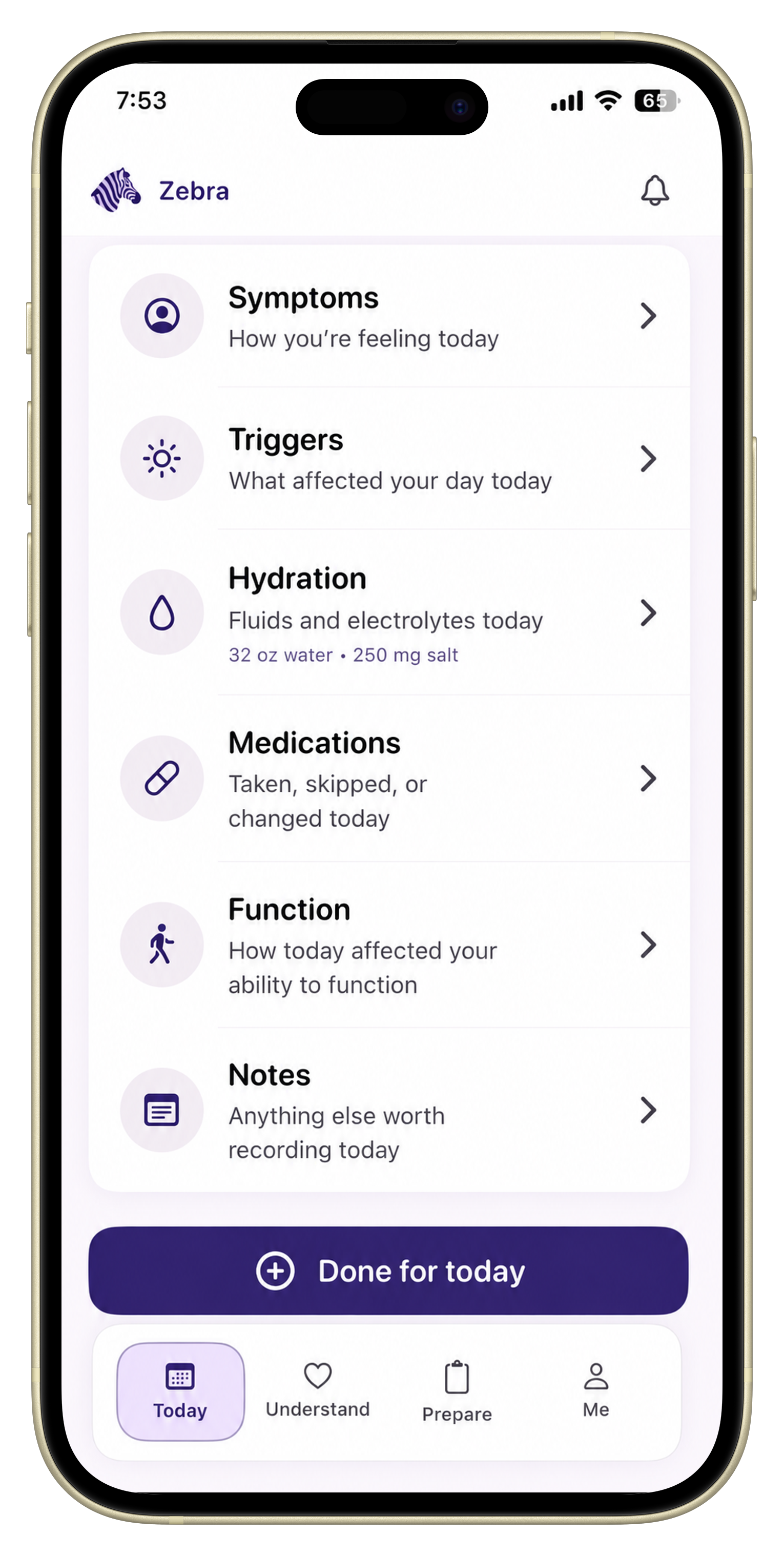
Zebra helps keep orthostatic test notes, symptoms, blood pressure, heart rate, medications, hydration, triggers, recovery, and appointment questions in one place.
It does not diagnose orthostatic hypotension or interpret readings. It helps you bring a clearer record to the person who can.
Track posture, time, blood pressure, heart rate, symptoms, what you were doing, meals, medication timing, hydration context, and how long it took to recover after sitting or lying down.
No. Home notes can help your clinician see a pattern, but diagnosis and treatment decisions need clinical evaluation.
Stop if you feel unsafe, faint, develop severe symptoms, or your clinician gave you stop rules. Sit or lie down and seek medical help for concerning symptoms.
No. Do not change treatment based on home readings alone. Bring the pattern to your clinician and ask what changes are appropriate for you.
No. Orthostatic hypotension focuses on a blood pressure drop after standing. POTS focuses on an excessive heart rate increase without significant orthostatic hypotension. A clinician can help interpret which pattern fits.
Put this into practice
Use Zebra to keep orthostatic symptoms, blood pressure, heart rate, medications, meals, hydration, and appointment questions in one timeline.
Download ZebraKnowledge hub
Keep exploring
A practical guide to tracking near-fainting, lightheadedness, and strange dysautonomia episodes without relying on memory.

A practical guide to tracking neck-and-shoulder coat-hanger pain, heavy limbs, and upright fatigue with enough context for a medical appointment.
A practical guide to tracking sick-day POTS flares, infection symptoms, fever, hydration, salt, medication timing, heart rate, dizziness, fatigue, recovery, and doctor-ready summaries.
A practical guide to tracking morning POTS symptoms, getting out of bed, hydration, salt, breakfast, medication timing, heart rate, blood pressure, dizziness, brain fog, recovery, and doctor-ready summaries.