
POTS Home Test Notes: What to Record With Heart Rate and Blood Pressure
A practical guide to recording heart rate, blood pressure, symptoms, and context for POTS or orthostatic intolerance conversations.

Zebra
For invisible chronic illness
Appointment Preparation
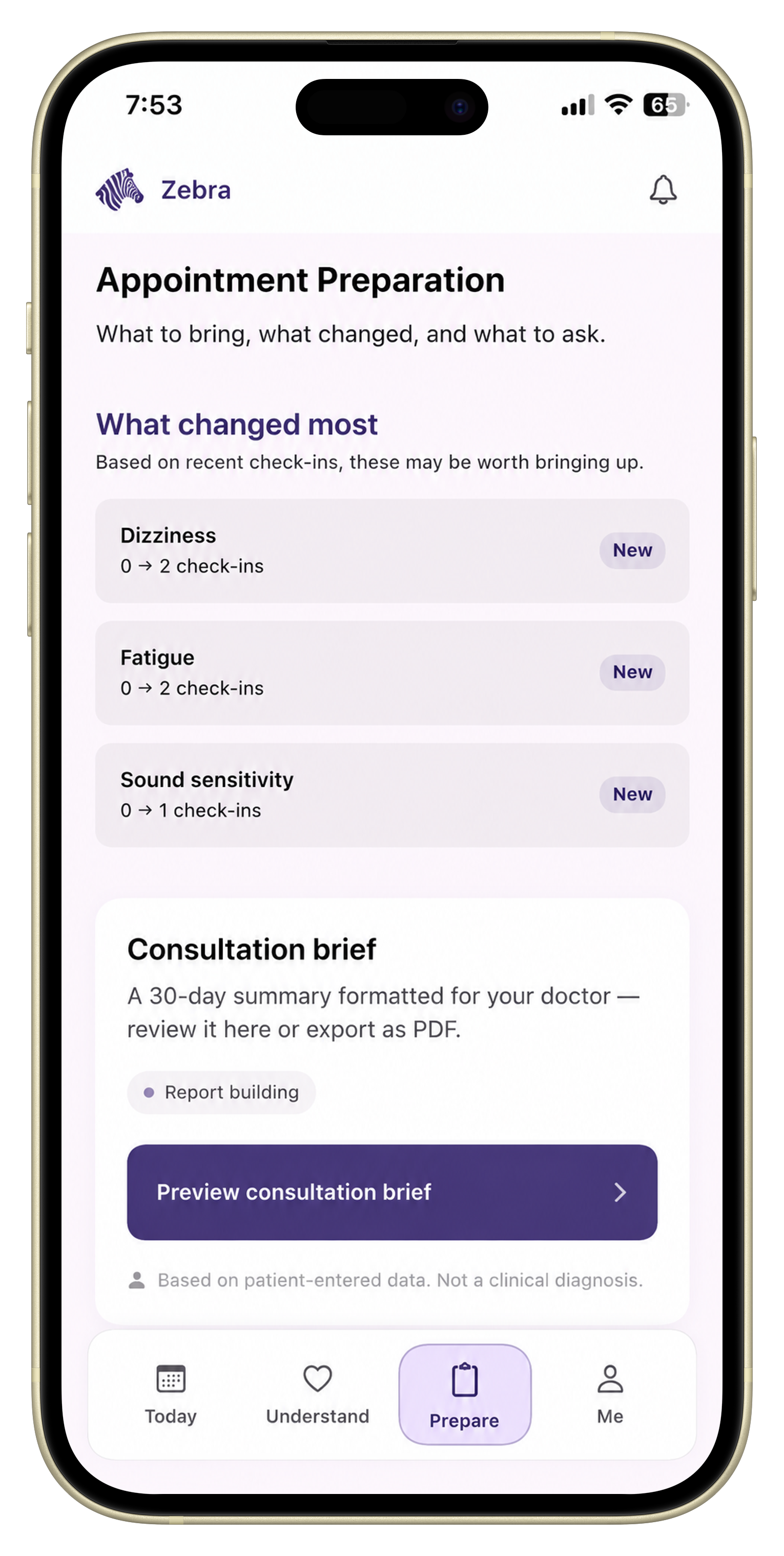
For a POTS cardiology appointment, the most useful things to bring are a short symptom summary, a medication and supplement list, relevant home heart rate or blood pressure observations, and a clear list of questions. You do not need a perfect binder. You need the information that helps your cardiologist understand what happens when you are upright, what changed recently, and what is affecting daily life.
For a POTS cardiology appointment, the most useful things to bring are a short symptom summary, a medication and supplement list, relevant home heart rate or blood pressure observations, and a clear list of questions. You do not need a perfect binder. You need the information that helps your cardiologist understand what happens when you are upright, what changed recently, and what is affecting daily life.
Cardiology visits are easy to waste when the whole story is trapped across memory, screenshots, and scattered notes. A short, focused record is usually more helpful than a huge pile of unorganized tracking.
Focus on the symptoms that matter most:
Include what changed recently and what seems most disruptive.
If you have been tracking lying, sitting, or standing observations at home, bring a clean summary. Do not worry about making it look clinical. The useful part is showing the pattern clearly.
For example:
Keep this as context, not as self-diagnosis.
Bring:
This helps the visit move faster and reduces the chance of forgetting something important.
If symptoms change with:
bring a short note on those patterns. You do not need certainty. You need useful context.
Some good questions are:
Try not to bring:
Your cardiologist usually needs the clearest version first.
Use this format:
This is often enough for a much better conversation.
Zebra is built for exactly this workflow. It helps keep symptoms, flares, hydration, salt, medications, and orthostatic observations in one record so you can review them before the appointment instead of rebuilding the story from memory.
That is especially useful for people managing POTS alongside EDS, Fibromyalgia, or other overlapping symptoms that are easy to scatter across different tools.
Bring a symptom summary, medication list, relevant heart rate or blood pressure observations, flare notes, and a short question list.
If you have them, yes. A clean summary is often more useful than a large pile of screenshots.
Only if they are relevant to the visit or your clinician asked for them. Symptom and function history still matter too.
Bring it anyway. A short recent record is still better than relying entirely on memory.
Put this into practice
Track the month before your appointment in Zebra.
Download ZebraKnowledge hub
Keep exploring
A practical guide to recording heart rate, blood pressure, symptoms, and context for POTS or orthostatic intolerance conversations.
A practical guide to tracking symptoms and context after a positive tilt table test for clearer follow-up appointments.
A practical guide to choosing the best app for dysautonomia cardiology appointment preparation.
A practical guide to choosing the best app for POTS cardiology appointment preparation.