How to Track Brain Fog Symptoms for a Doctor Appointment
Learn how to track brain fog symptoms, function changes, and context so the history is easier to explain at appointments.

Zebra
For invisible chronic illness
Brain Fog and Difficult Days
If you have brain fog, the best symptom journal is the one you can still use when your thinking is slow, your memory feels unreliable, and writing a full paragraph feels impossible. That usually means a shorter structure, fewer decisions, and a lower bar for what counts as a useful entry.
If you have brain fog, the best symptom journal is the one you can still use when your thinking is slow, your memory feels unreliable, and writing a full paragraph feels impossible. That usually means a shorter structure, fewer decisions, and a lower bar for what counts as a useful entry.
A symptom journal does not fail because you miss details. It fails when the process asks more from you than you can give on the days you need it most.
A brain-fog-friendly symptom journal should be:
It should not require you to be articulate, motivated, or organized in the moment.
On a hard day, one useful entry can be as simple as:
Example:
That is enough to help future you understand the day later.
Blank pages create too many decisions.
Use the same prompts every time:
You do not need a diary voice. You need a structure.
One of the fastest ways to abandon a symptom journal is to miss a few days and then feel pressured to rebuild everything from memory.
If you missed days:
A partial real record is more useful than a perfect imaginary one.
When your energy is low, track:
That gives you the highest-value history with the least effort.
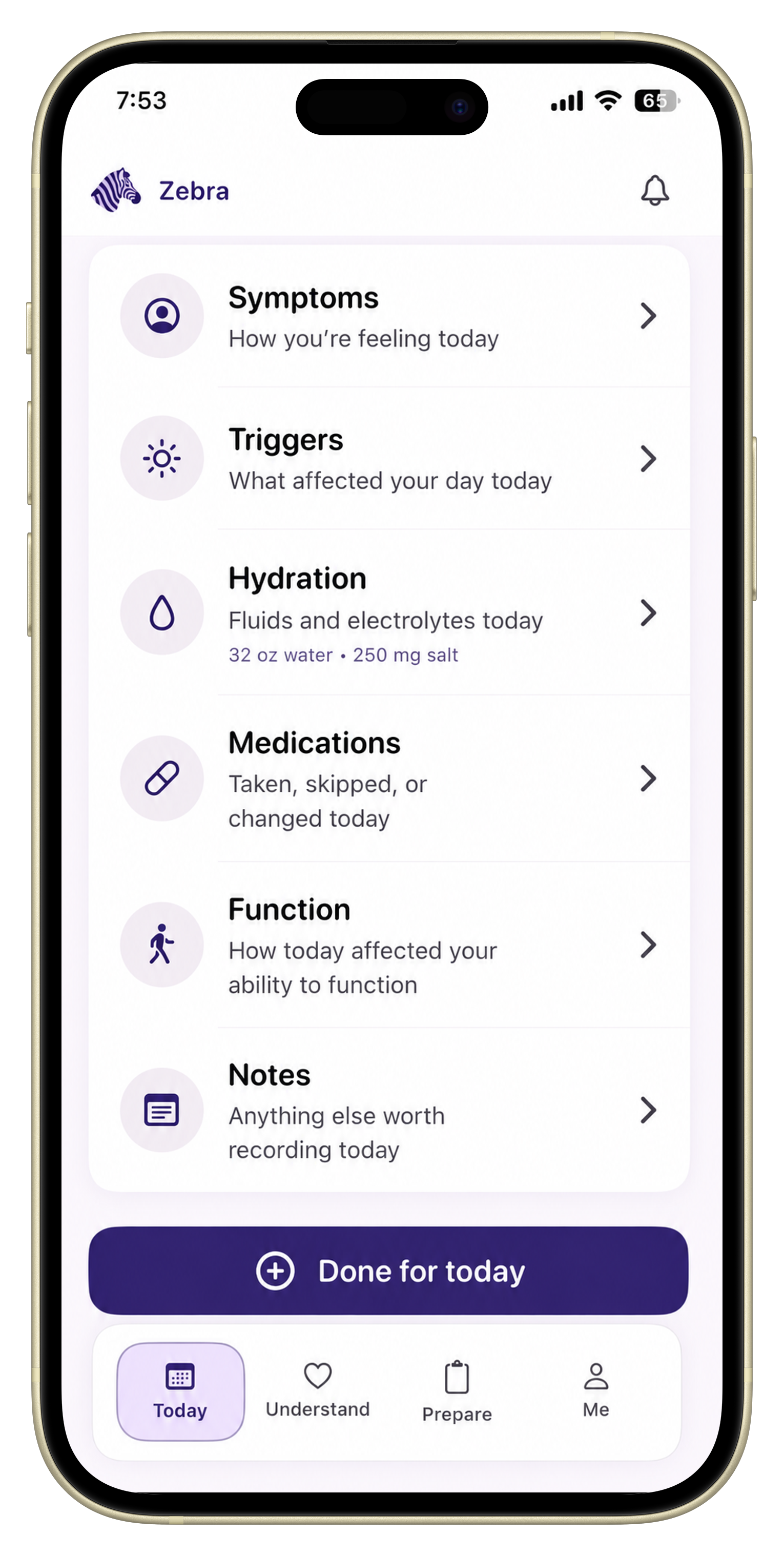
Zebra is built around short structured tracking instead of long-form journaling. That is especially useful for people dealing with brain fog, flares, and overlapping conditions who need a record they can still use before appointments.
Use a short repeated structure instead of a blank page. Track symptoms, changes, and function impact in the smallest useful format.
The strongest symptom, what changed, and one line about how it affected your day is often enough.
No. Restarting today is usually more sustainable than trying to rebuild everything perfectly.
Put this into practice
Use Zebra to keep the minimum useful record on brain-fog days.
Download ZebraKnowledge hub
Keep exploring
Learn how to track brain fog symptoms, function changes, and context so the history is easier to explain at appointments.
Learn why symptom tracking often falls apart on bad days and how a lower-effort approach can make it more sustainable.
A practical guide to tracking cycle-related flares, POTS symptoms, fibromyalgia pain, fatigue, brain fog, GI symptoms, medications, and appointment questions.
A practical guide to tracking migraine and headache days, symptoms, medication response, possible triggers, sleep, hydration, menstrual cycle context, and appointment-ready summaries.